

No business operates in a vacuum. A company’s performance depends not only on its own decisions but also on what competitors are doing — changing prices, launching new products, running advertising campaigns, entering new sales channels, or adjusting their market positioning. This is why competitor analysis is an important part of market research and business planning.
What is competitor analysis?
Competitor analysis is the systematic process of studying companies that target the same customers or address the same customer needs. It is important to consider not only direct competitors offering similar products or services, but also indirect competitors that provide alternative ways of solving the same problem.
Companies can also be grouped into strategic groups — businesses within the same industry that have similar positioning, pricing, target audiences, and business models. For example, premium sports car manufacturers compete much more directly with one another than they do with mass-market automotive brands.

For startups and small businesses, this type of analysis can be especially valuable. It helps identify who the real competitors are and how a company’s offering can stand out from the alternatives already available in the market.
Why companies analyze their competitors
The main purpose of competitor analysis is not to copy what other companies are doing, but to gain a better understanding of the market. Studying competitors can reveal their strengths and weaknesses and provide insight into pricing, product ranges, service quality, marketing strategies, and customer experience.
Comparisons can also help businesses identify market gaps and unmet customer needs. Customer reviews, for example, may reveal recurring complaints about inconvenient delivery options, complicated ordering processes, insufficient product information, poor customer support, or limited selection. These insights can help a company improve its own products and services.
Competitor analysis also makes it easier to recognize changes in the market at an early stage. If several competitors begin adjusting their prices, introducing new service models, or investing heavily in a particular sales channel, this may indicate a broader shift in customer demand or buying behavior. Monitoring these signals regularly allows a business to adapt its strategy more quickly.
What should be analyzed?
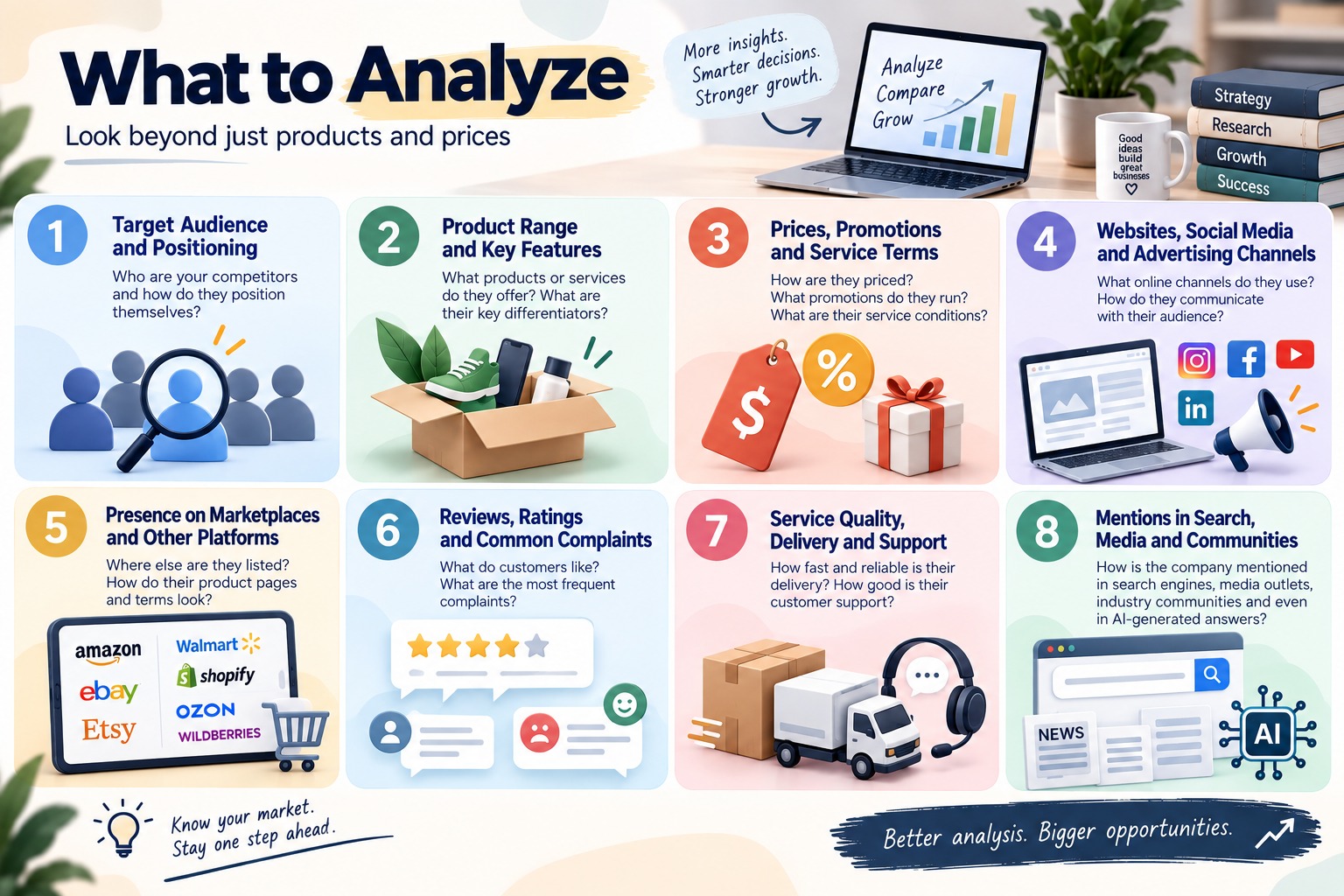
Competitor analysis should go beyond comparing products and prices. Key areas to review include:
- target audiences and market positioning;
- product or service ranges and key features;
- prices, promotions, and terms of service;
- websites, social media presence, and advertising channels;
- presence on marketplaces and other sales platforms;
- customer reviews, ratings, and common complaints;
- the quality of customer service, delivery, and support;
- brand mentions in search results, media outlets, industry communities, and AI-generated answers.
It is also important to evaluate competitors from the customer’s perspective. Consider how easy it is to find relevant information, place an order, contact the company for assistance, and resolve an issue after a purchase.
Competitor analysis is an ongoing process
A one-time competitor report can quickly become outdated. Businesses regularly change their products, prices, and marketing strategies, while new competitors and customer acquisition channels continue to emerge. For this reason, ongoing monitoring of important market developments is generally more useful than conducting competitor research only occasionally.
Effective competitor analysis helps businesses do more than simply react to other companies’ actions. It supports better-informed decisions about target audiences, pricing, product development, customer experience, and opportunities for growth.
Ultimately, the goal is to understand how a company can deliver greater value and become a more attractive choice for customers. Regular competitor monitoring can also help businesses identify potential threats earlier and take advantage of new market opportunities as they emerge.