

Automation plays an important role in modern business. Companies use it to save time, reduce costs, and improve daily operations.
Many business tasks are repetitive. Employees may need to enter data, process invoices, schedule meetings, prepare documents, or create reports. Doing these tasks by hand takes time and can lead to mistakes.
Automation helps companies complete routine work faster and with greater accuracy.
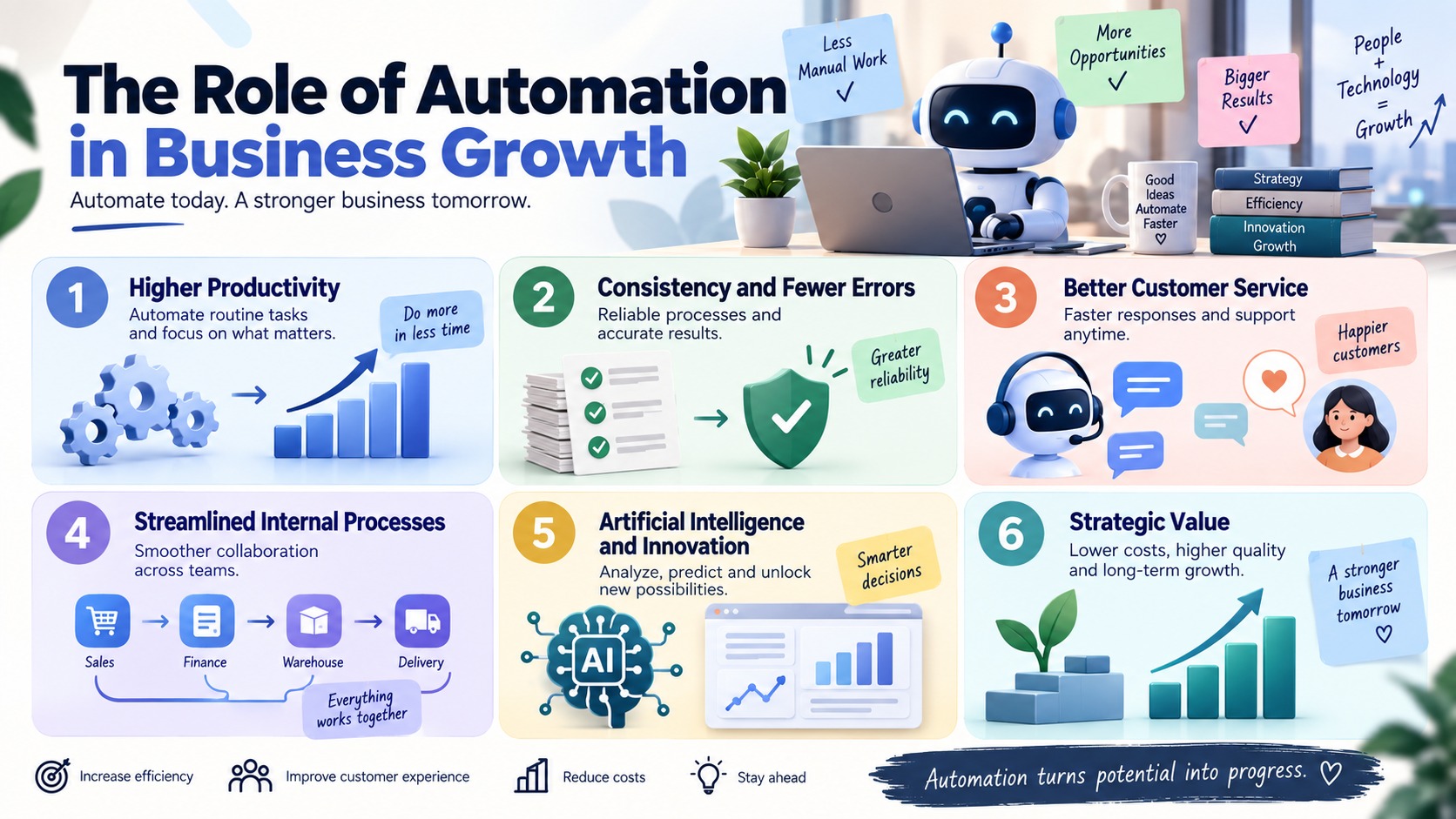
Higher productivity
One of the main benefits of automation is higher productivity.
Automated systems can handle simple and repetitive tasks. This gives employees more time for work that requires human skills.
For example, employees can focus on customers, business growth, new ideas, and problem-solving. They can also spend more time on tasks that require experience and creativity.
Automation is also useful when a company works with large amounts of data. Software can often process information much faster than a person.
Fewer errors and more consistent work
Automation can make business processes more reliable.
Automated systems follow clear rules. They do not get tired or distracted. As a result, they can reduce mistakes in routine tasks.
This is important for companies that need to follow internal rules, legal requirements, or quality standards.
However, people are still important. Employees should monitor automated systems and make decisions in unusual or complex situations.
Better customer service
Automation has also changed customer service.
Chatbots can answer common questions. Automated systems can send customer requests to the right department. Self-service tools can also help customers solve simple problems on their own.
These technologies can reduce waiting times and improve response speed.
Companies can also support more customers without increasing support costs at the same rate.
At the same time, customer service teams can focus on more difficult cases. These situations often need personal attention and human judgment.
Better internal processes
Automation can improve how different departments work together.
Information can move automatically between teams and systems. This reduces manual work and gives employees faster access to important data.

For example, when a customer places an order, the information can be sent automatically to sales, finance, inventory, and shipping teams.
This can reduce delays and make the process easier to manage. It can also help companies make faster decisions.
Artificial intelligence and automation
Artificial intelligence is making automation more advanced.
Traditional automation usually follows fixed rules. AI systems can do more. They can analyze data, find patterns, create forecasts, and support business decisions.
AI can also help employees complete more complex tasks.
As AI technology develops, businesses will be able to automate more processes. This may include work that once required a large amount of manual analysis.
The business value of automation
Automation is not only a way to reduce manual work. It can also support business growth.
Companies can use automation to improve productivity, reduce costs, provide better service, and scale their operations.
It can also help businesses use their people and resources more effectively.
For companies in the United States, Europe, and other global markets, automation is becoming an important part of efficient and flexible business operations.
Businesses that automate the right processes can adapt faster, serve customers better, and compete more effectively.