

Starting your own business does not necessarily require a large amount of money, an office, or a team. You can often start with what you already have: a useful skill you can turn into a service, a simple product, consulting expertise, or work tailored to a specific customer need.
When exploring business ideas for beginners, it makes more sense to focus on how easy an idea is to test rather than how ambitious it sounds. Is there real demand for it? Are people willing to pay? Can you land your first customers without making a major upfront investment?
Starting small allows you to validate demand, learn what customers actually want, and decide whether the idea is worth expanding before committing more time and money.
What business should a beginner start?
A good beginner business solves a specific customer problem and can be tested without taking on unnecessary financial risk.
Before getting started, consider your skills, available time, startup costs, competition, and potential profit margins. In many cases, the smartest approach is to test the idea as a side hustle first. Find a few paying customers, collect feedback, refine your pricing, and improve the offer before trying to scale.
Home-based business ideas
When looking for profitable business ideas for beginners, it is better to think in terms of clear revenue models and low startup costs rather than promises of fast money.
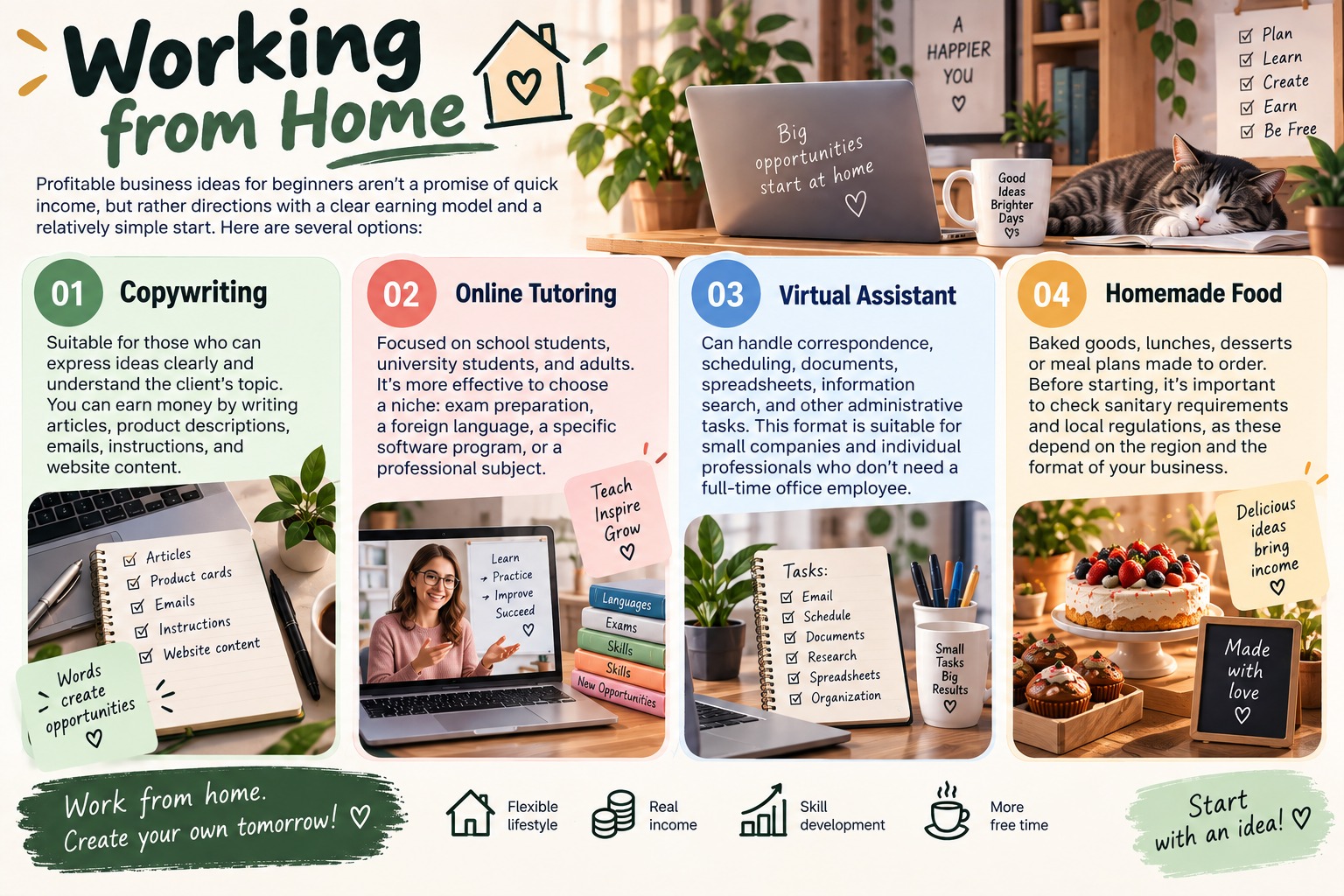
- Copywriting can be a good fit for people who write clearly and know how to understand a client’s audience. Freelance copywriters can create blog posts, product descriptions, email campaigns, website copy, landing pages, guides, and other marketing content.
- Online tutoring can serve K-12 students, college students, and adults. It is usually easier to market a focused service rather than general tutoring. Examples include SAT or ACT prep, math tutoring, English as a Second Language, help with college-level subjects, or training in a specific software program or professional skill.
- Virtual assistant services may include managing email, scheduling appointments, preparing documents and spreadsheets, conducting online research, handling customer inquiries, and performing other administrative tasks. This type of service can be especially useful for freelancers, consultants, solo business owners, and small companies that do not need a full-time employee.
- Home-based food businesses are another option. Depending on your skills, you might sell baked goods, desserts, meal prep, specialty foods, or made-to-order products. Before launching, check your state’s cottage food laws, food safety requirements, local health department rules, zoning restrictions, and any permits or licenses that may apply.
Online and digital business ideas
When deciding what business to start as a beginner, it is more useful to compare the practical requirements of each option than to chase whatever industry currently seems the most exciting.

Consider what skills you already have, how long it will take to learn what you need, how much the business will cost to start, and whether you can test demand before making a major investment.
- Web development can work well for people with technical skills. Beginners can start by building landing pages, websites for local businesses, simple e-commerce stores, or portfolio sites. Your first projects can help you build a portfolio, collect testimonials, and generate referrals.
- Digital marketing includes areas such as paid advertising, social media management, email marketing, content creation, SEO, and analytics. When starting out, it is often easier to specialize in one service and one type of customer. For example, you might manage social media for local restaurants, provide email marketing for online stores, or create content for real estate agents.
- Creating online courses can make sense if you have practical expertise that can be turned into a clear learning outcome. Rather than teaching a broad topic, focus on helping customers achieve a specific result, such as learning a software tool, mastering a workplace skill, preparing for an exam, or completing a particular project.
- Print-on-demand allows you to sell products without purchasing inventory in advance. T-shirts, hoodies, mugs, posters, tote bags, phone cases, and other items are produced after a customer places an order. The biggest challenge is usually not manufacturing but finding a specific audience and creating designs that appeal to that niche.
Local service business ideas
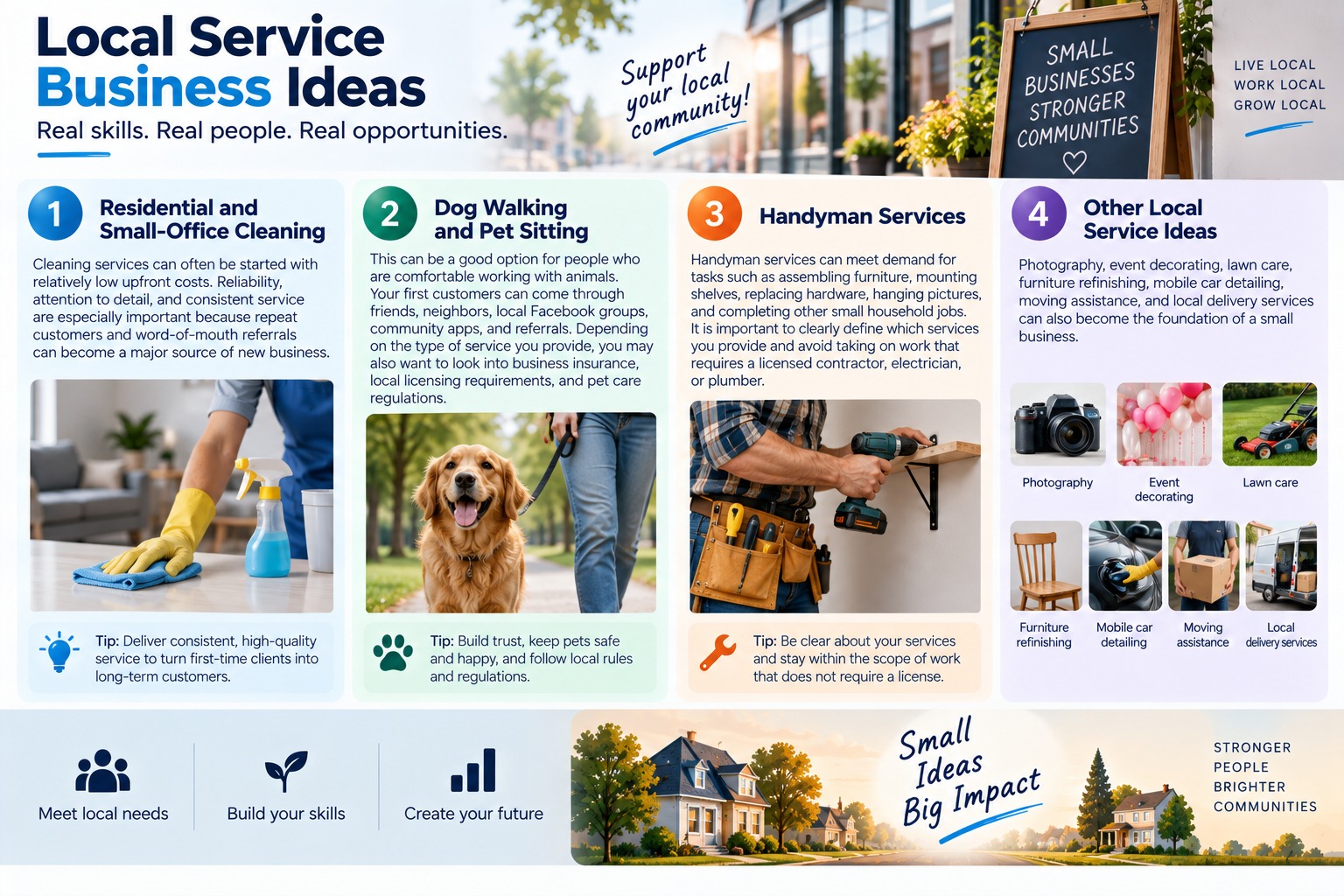
- Residential and small-office cleaning can often be started with relatively low upfront costs. Reliability, attention to detail, and consistent service are especially important because repeat customers and word-of-mouth referrals can become a major source of new business.
- Dog walking and pet sitting may be a good option for people who are comfortable working with animals. Your first customers can come through friends, neighbors, local Facebook groups, community apps, and referrals. Depending on the type of service you provide, you may also want to look into business insurance, local licensing requirements, and pet care regulations.
- Handyman services can meet demand for tasks such as assembling furniture, mounting shelves, replacing hardware, hanging pictures, and completing other small household jobs. It is important to clearly define which services you provide and avoid taking on work that requires a licensed contractor, electrician, or plumber.
- Photography, event decorating, lawn care, furniture refinishing, mobile car detailing, moving assistance, and local delivery services can also become the foundation of a small business.
The best option is usually one where your existing skills overlap with real customer demand rather than simply choosing a niche because it is currently popular.
How to start a small business
You do not need to build a large company from day one. Start with one clear offer and try to find your first paying customers.
Calculate your costs, estimate how much time each job will take, and test whether customers are willing to pay your target price. Once you begin getting consistent orders, improve your processes, collect reviews and referrals, and gradually expand your services.
You should also consider the basic legal and financial side of running a business. Depending on your situation, this may include choosing between operating as a sole proprietor or forming an LLC, registering a business name, obtaining required licenses, opening a separate business bank account, keeping records of income and expenses, and understanding your federal, state, and local tax obligations.
For a beginner, a good business is one that can be launched with manageable risk, tested with real customers, and gradually developed into a sustainable and profitable operation.